Recording Details
- Title
- Lenox Music Inn 1973
- Label
- Concert Vault
- Release Date
- 2014
- Medium
- Download
- Availability
- Very Good (Streaming)
- Venue
- Music Inn, Stockbridge, MA
- Recording Date
- September 1, 1973
Lineup
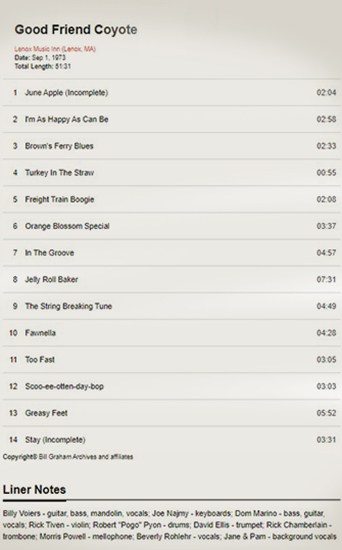
- Billy Voiers — guitar, bass, mandolin, vocals
- Rick Chamberlain — trombone
- Joe Najmy — keyboards, accordion, piano
- Robert “Pogo” Pyon — drums, vocals
- Dom Marino — bass, guitar, vocals
- Morris Powell — mellophonium
- Rick Tiven — violin
- Beverly Rohlehr — vocals
- David Ellis — trumpet
- Jane & Pam — background vocals
Set List
- June Apple
- Jelly Roll Baker
- I’m As Happy As Can Be
- The String Breaking Tune
- Brown’s Ferry Blues
- Fawnella
- Turkey In The Straw
- Too Fast
- Freight Train Boogie
- SCOO-EE-OTTEN-DAV-BOP
- Orange Blossom Special
- Greasy Feet
- In The Groove
- Stay
History
On this entire website, I struggled the most to find information about Good Friend Coyote, especially considering that they are featured on Wolfgang’s Vault, where you can stream one of their live shows. Outside of that, they didn’t seem in 2016 when I was doing my initial research. With the advent of the AI and better search engines on the internet, as well as a timely call with founder Billy Voiers, I have been able to put together a comprehensive biography. The band was formed in the summer of 1971 and broke up in early 1974. They were based in Berkshire, Massachusetts and were a successful touring band, playing many colleges and high profile venues in the Northeast.
Their members were all highly trained musicians, with jazz, swing, country, classical, rock, and blues backgrounds. At least two of them attended New England Conservatory, another attended the Berklee School of Music and nearly all of them had successful musical careers after the band dissolved. They reunited for a one time show in 2012 and they were closely associated with the jazz scene around the Lenox School Of Jazz and the Music Inn in Lenox and Stockbridge, MA.
The group was formed by guitarist Billy Voiers and drummer Robert “Pogo” Pyon, who were members of the West Texas group Onion Creek in the sixties. Voiers had been mentored by guitarists Jim Mings and Johnny Richardson. While hitchhiking in October 1970, Voiers was picked up by Joe Najmy. Sometime later, Voiers and Pyon were renting an apartment in Boston and washing dishes at the New England Conservatory to pay the bills. Najmy visited and introduced them to Dom Marino (bass/guitar) and Scott Dufault. Najmy, Marino, and Dufault were renting a house in Lanesboro, MA at the time.
In the spring of 1971, Voiers and Pyon started rehearsing with Najmy and Marino in Lanesboro every weekend. The two would take a bus to nearby Pittsfield and Najmy would pick them up. They called their new band Good Friend Coyote, which was taken from a southwest legend that coyotes brought fire to the earliest indigenous people. As time went by, the four members began to add others to the band. Rick Tiven (violin) was working as a cook at the NEC when he met Voiers and Pyon. He was a scholarship student at the school at the time.
It turned out that Tiven was rooming with trombonist Rick Chamberlain, who knew trumpeter David Ellis and mellophonium player Morris Powell (the mellophonium sounds like a French Horn and is sometimes used in marching bands). All three wound up joining the band. Finally, the lineup was rounded out by r&b and jazz singer Beverly Rohlehr. She would also be augmented by two other female backup singers at times, now only remembered as Jane and Pam.
By the summer of 1971, Good Friend Coyote was playing their first gigs. They played an eclectic combination of jazz, bluegrass, swing, country, big band, New Orleans jazz, rock, and blues. Their ability to jump from style to style was impressive. While they were working with Shaggy Dog Studios to record some demos, they did not get any label interest primarily because it was hard to figure out how to market them.
The band toured between the summer of 1971 and into 1974. They were popular on the college circuit and opened for artists like Roy Buchanan, Dave Bromberg, Hot Tuna, and Lou Reed. They were popular enough to land gigs at the Lenox Inn and Tanglewood, where they opened for national artists. Their concerts were often described as lively affairs, with plenty of storytelling and dialogue between impeccably performed songs. However, the inability to land a record contract held them back and they eventually drifted apart.
Most of the musicians in the band went on to have successful professional careers. Voiers has been a fixture in the Berkshires music scene his entire life. He formed a successful group called the Milestones and continues to perform as of 2025 as a member of the BTUs. Pyon left the band in 1973 to study electrical, computer, and energy engineering. He later taught at the University of Colorado, where he recently retired.
He was replaced by Eric Parker, who went on to play with Valerie Carter, Bonnie Raitt, John Hall, Mick Taylor, Ian Hunter, Steve Winwood, John Sebastian, and Joe Cocker among many others. As of 2025, he lives in the Hudson Valley and still continues to do session work and performs locally.
Tiven has also made a successful living as a musician. Since Good Friend Coyote, he has played with the Shy Americans, the Pickwell Brothers, Clean Living, The Coyote Sisters, Norman Schell, and Empire Brass. He remains active as of 2025. Joe Najmy is presently (2025) a member of the successful Connecticut band, Otis And The Hurricanes. After leaving Good Friend Coyote, Najmy played with Average White Band, Bonnie Raitt, Taj Mahal, and Robert Cray.
Beverly Rohlehr has also had a very successful career as a professional singer. For a time, she was the first, and only ever, female member of the Persuasions, recording one album with them. She has been the lead vocalist for big jazz bands like Mel Lewis Jazz Orchestra and the National Jazz Ensemble. As of 2025, she is a member of the Colbys Band, based in Pittsburgh, PA. The band has just released a new CD called Every Ounce (2025).
David Ellis played professionally in New York until the early eighties, when he returned to his home in Vermont to help his father run a long standing and very successful music store. That store, Ellis Music, is still located in Bethel, Vermont and is a local institution, renting, repairing, and selling instruments to thousands of students over its seventy five year plus history. Ellis continues to run it as of 2025 with his two sisters.
Rick Chamberlain graduated with a Bachelor Of Music Degree and moved back home to the Pocono Mountains to begin his professional career. He was a member of Bob Newman’s house band at the Mount Airy Lodge, founded the Delaware Water Gap Celebration Of the Arts in 1978 with mentor Phil Woods, played in NYC Broadway pit orchestras, recorded jingles, and worked, toured, and recorded with Louie Bellson, Engelbert Humperdinck, Chuck Mangione, Joni Mitchell, and Gerry Mulligan. He was also a regular player with the New York City Ballet, the American Composers Orchestra, and the Westchester Philharmonic. He passed away on March 27, 2015.
Dom “D.B” Marino is involved with various bluegrass organizations and still active in music. Morris Powell was a very successful classical musician, eventually moving to Antwerp, where he was a horn player in the Dutch Radio Orchestra as well as the Antwerp Symphony Orchestra.
Voiers, Najmy, Tiven, Marino, and Chamberlain reunited in 2012 under the Good Friend Coyote name at a Music Inn Center reunion. They were accompanied on stage by Dino Marino, Peter Adams, Charlie Tokarz, Scott Dufoe, and Mark Papas. It was the first time the group had performed under that name in thirty years.
About This Recording
The Wolfgang’s Vault recording was made at the Music Inn on September 1, 1973. It is available through the Music Inn Archives project. At the time, the group was popular, playing shows throughout New England. On this particular night, they were paired with Lou Reed. The band members apparently had a longstanding relationship with the Music Inn, where they played a couple of other times.
The recording begins with a bluegrass heavy version of “June Apple,” which features Tiven on violin and Najmy on piano. The bluegrass theme continues with a mandolin heavy version of “I’m As Happy As I Can Be,” featuring Voiers on mandolin and vocals. Tiven’s violin is also heavily present, as are the harmony vocals of Marino. Najmy contributes a keyboard solo.
“Brown’s Ferry Blues” is another fast paced western swing song. It features Voiers, Marino, and Pyon on vocals. Voiers is on mandolin and Tiven contributes another violin solo. After a brief snippet of “Turkey In The Straw” featuring Tiven and Najmy, as well as various animal sound effects, the group pulls out the electric guitar for a swing version of “Freight Train Boogie.” This one is played at an insane pace, with Pyon and Marino pulling the group on a wild ride. Tiven’s violin work is remarkable, and Voiers pulls off some nice rockabilly-like guitar work. Marino’s lead vocals are outstanding.
“Orange Blossom Special” is played at an insane pace and features some nice right/left speaker phasing. Once again, it’s Tiven’s show, with Pyon matching him note for note on drums. The ensemble vocals of the three men are outstanding.
The next several tracks feature the non-bluegrass/swing version of the band. Voiers leads off on lead vocals/harmonica in the New Orleans jazz based “In The Groove.” The song features Najmy on piano, Tiven on violin, and Voiers on guitar — a terrific piece of music from start to finish. “Jelly Roll Baker” continues the New Orleans theme and marks the first appearance of the Chamberlain/Ellis/Powell horn section. Voiers handles lead vocals; the song has plenty of blues influences, with solos by Najmy, Ellis, Chamberlain, Powell, Tiven, and Voiers.
“The String Breaking Tune” is a jazz guitar based instrumental, with Voiers showing off considerable technique — big band based, completely different from the swing and bluegrass music that leads off this set. Najmy contributes a nice electric piano solo, and the ensemble horn work is outstanding. Ellis’ trumpet solo blends in strangely well with Tiven’s violin solo.
“Fawnella” marks the first appearance of singer Beverly Rohlehr, who sings lead accompanied by backup singers Jane and Pam. It’s the most rock-oriented piece on the album, with a strong guitar, bass, and drum blues based foundation. Rohlehr’s lead vocals are very strong, with a grit and intensity that matches the song perfectly. Voiers’ guitar solo is phased between the right and left channels, and Najmy pulls off a great piano solo while Tiven and Voiers trade violin and guitar licks.
The three female singers hang around for a blisteringly fast version of the appropriately titled “Too Fast.” Tiven dominates, with Marino on lead vocals. The band returns to jazz with the Texas swing based “SCOO-EE-OTTEN-DAV-BOP” — the ensemble horn work is outstanding, Tiven is again featured on violin, and the rhythm work of Marino and Pyon is powerful.
The group’s encore is a drum-and-bass-heavy instrumental version of “Greasy Feet.” Everyone takes a solo and the vibe is terrific — it showcases just how talented and tight this band was. While they never found a niche in the record industry, they clearly knew how to put on a show.
The tape ends with an incomplete version of a song called “Stay,” with a Flying Burrito Brothers-like feel. The torch-like vocals of Voiers and the other singers dominate over a ballad pace with a church organ solo from Najmy.
In the end, Good Friend Coyote was a kick-ass ensemble that had so many identities and played so many styles of music that it’s not surprising they were never signed. That makes this recording — which can now only be streamed on Wolfgang’s Vault — not essential, but an enjoyable romp by eleven musicians who knew their trade.